US Deploys Third Carrier as Midterm Ballots Hit 21 Million
Military buildup in the Middle East coincides with a surge in early voting, while grocery prices remain a focal point for voters.
By Karim Ramirez ·
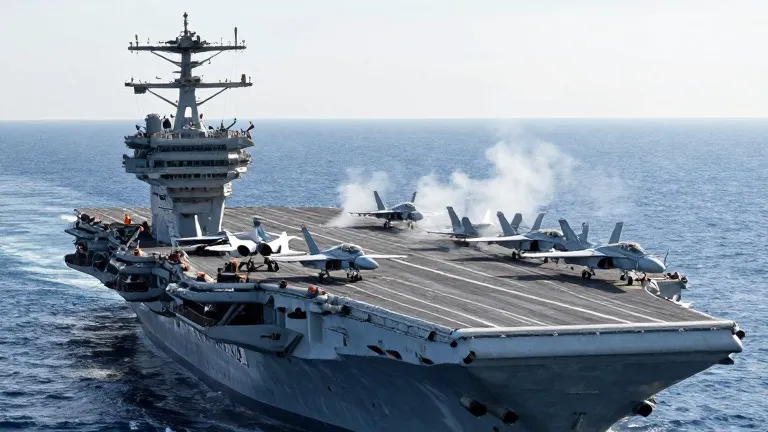
The United States is moving a third aircraft carrier to the Middle East as nearly 21 million Americans cast ballots ahead of the November 3 midterm elections. The deployment signals a potential shift in regional strategy, occurring just as domestic voting surges and inflationary pressures from global conflicts weigh on household budgets.
According to a person briefed on U.S. and Israeli war planning, the two nations are preparing for a possible attack on Iran following the U.S. vote. Defense Secretary Pete Hegseth traveled to Israel recently to meet with Prime Minister Benjamin Netanyahu. NPR’s Greg Myre noted that President Trump is likely to delay major military action until after the election to prevent a spike in oil prices before voters go to the polls.
Iran has stated it is prepared for both diplomacy and war. Foreign Minister Abbas Araghchi said Tehran is ready for either path. Myre observed that while the U.S. and Israel possess the power to inflict heavy damage, Iran shows no sign of making major concessions. Instead, Tehran is demanding formal control of the Strait of Hormuz and the withdrawal of U.S. troops from the region.
Voting activity has accelerated in the United States. The University of Florida’s Election Lab reported that nearly 21 million Americans have voted by mail or in person, a figure that rose by about 2 million in a single day. NPR’s Saige Miller noted that early voting in key battleground states is higher than during the last midterm cycle. However, Miller cautioned that early figures do not guarantee final results, as Democrats tend to vote earlier while Republicans often turn out on Election Day.
A federal judge in California is restricting pre-election field operations by the Department of Homeland Security. The department said its efforts aim to identify noncitizens who allegedly voted illegally in nine states. In a separate legal development, a federal magistrate judge ruled that President Trump must sit for a deposition in his $10 billion defamation case against the BBC. The judge said he must comply with court rules or face sanctions.
The lawsuit centers on a Panorama broadcast from late October 2024 that allegedly edited his January 6 speech to make it appear he incited a violent siege of Congress. Trump has called the broadcast false, misleading, and defamatory under Florida law. The BBC, which apologized for the splicing, seeks to understand his state of mind during the speech. BBC attorneys said more than 200 January 6 defendants stated the speech motivated them. The network is also seeking details on how Trump has profited since returning to the White House.
Grocery costs remain a concern for voters. While some items have become cheaper, overall grocery prices have risen due to higher labor costs, tariffs, and energy prices linked to the conflict with Iran. Ground beef reached $6.79 per pound last month, an 85% increase over the past decade, according to the Bureau of Labor Statistics. Eggs fell to $2.27 per dozen after a record $6.23 in March 2025. Butter averaged $3.96 in September, down 17.3% from a year earlier due to oversupply. Coffee remains 44% higher than two years ago despite the removal of tariffs.
The next phase of the military buildup includes the arrival of reinforcements in the Middle East, alongside the departure of some U.S. personnel from the region. In Washington, the focus shifts to the November 3 election, where results will determine the political landscape for the coming two years.
Source: NPR