
Sky maps show missing mass is not in giant black holes
New analysis of ancient light limits the size of hypothetical dark matter objects.
By Diego Ross ·
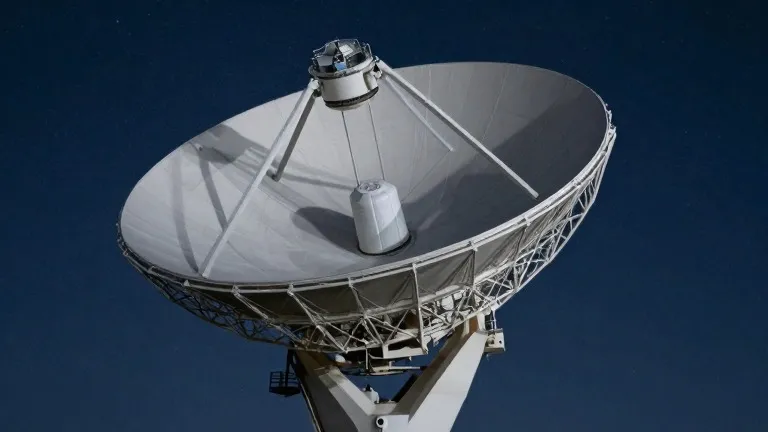
A new study finds that the universe's missing mass is not hidden inside extremely large black holes.
Scientists analyzed light from the early cosmos to test a specific theory. They looked for patterns that would appear if dark matter were clumped in massive objects. The data did not show these patterns.
The research team focused on black holes with masses exceeding 100 billion solar masses. Such objects would outweigh entire galaxies. The largest confirmed black hole currently weighs about 36 billion times the mass of the sun. No object of the size studied has been detected yet.
Christopher Gerlach is a theoretical physicist at the Mainz Institute for Theoretical Physics in Germany. He explained that dark matter is usually imagined as fine dust. If it were instead contained in a few huge bodies, the universe would look grainy on large scales. Gerlach stated that this graininess could be checked.
The researchers used the cosmic microwave background for their analysis. This radiation was released 380,000 years after the Big Bang. At that time, the universe cooled enough for light to travel freely. Antonio Iovino, a physicist at New York University Abu Dhabi, noted that the temperature of this background varies by one part in 100,000 across different parts of the sky. These variations map the distribution of matter in the infant universe.
Nicholas Leister, also at the Mainz Institute, said the background lacks the expected graininess. This absence indicates that the massive black holes cannot make up a significant portion of dark matter. The team clarified that the result does not prove these objects do not exist. It only shows they are not a primary component of the invisible mass.
The study appears in Physical Review Letters on October 26. The researchers are now investigating smaller black holes, roughly the size of asteroids, to see if those can explain the missing mass.
Source: Space.com