Beach Protests and Polling Tighten Brazil's Presidential Runoff
Tens of thousands rallied on Copacabana Saturday as 159 million Brazilians prepare to vote Sunday in a race where the polls show a dead heat.
By Karim Ramirez ·
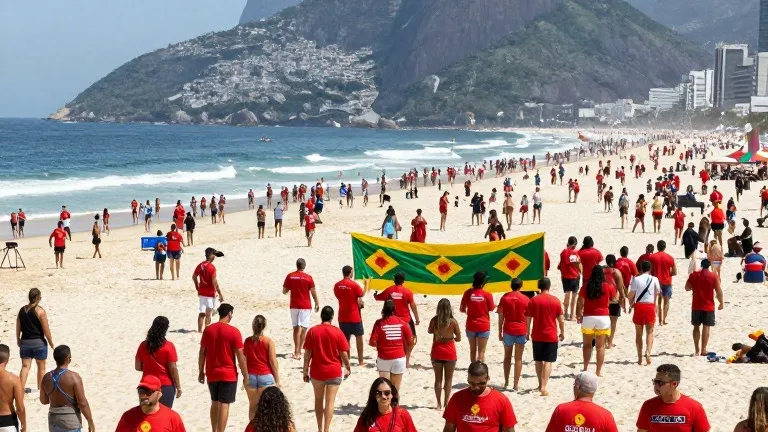
The sun beat down on Copacabana beach in Rio de Janeiro as tens of thousands of people in red shirts marched along the two and a half mile stretch of sand on Saturday.
The crowd, described as a carnival-like procession, gathered to support President Luiz Inácio Lula da Silva in the final day before the presidential runoff against Flávio Bolsonaro.
Activists unfurled a large yellow and green banner with the message, "WE ARE GOING TO TURN THIS AROUND!" Truck driver Josias Silva, 61, held a homemade sign reading "Lula re-elected. Tomorrow will be a new day."
Silva told reporters that recent street protests, many led by students, indicated that "the people have woken up." He predicted Lula would win more than 60 percent of the vote, a figure that exceeds current polling projections.
Close to 159 million Brazilians are eligible to cast ballots on Sunday. The two candidates are currently tied in the polls.
Bolsonaro won the first round on 4 October with 47 percent of the vote, compared to Lula's 45 percent. Since democracy was restored in Brazil in the 1980s, no candidate who lost the first round has advanced to win the runoff. A victory for Lula would therefore mark a historic break from that pattern.
Analysts view Bolsonaro as the slight favorite. Jair Bolsonaro, the father, served as president from 2019 to 2022 and is currently serving a 27-year prison sentence for plotting a coup after losing the 2022 election to Lula. His son has campaigned on a promise to confront violent crime with an iron fist.
However, Lula has recently regained momentum in the polls following scandals involving his opponent. Last week, the magazine Piauí reported that Flávio Bolsonaro attended a boat party with sex workers and vaccine lobbyists during the peak of the 2020 coronavirus outbreak.
For many voters, the election carries stakes beyond standard political disagreement. Brazilian press reports suggest that if Flávio Bolsonaro wins, several of his father's jailed or exiled allies in the coup plot could receive senior military and police posts.
Restaurateur Marta Moraes, 59, said her opposition was specifically to "Bolsonarismo" rather than the right wing as a whole. She stated that she lost four relatives due to Jair Bolsonaro's handling of the pandemic.
Many participants in the Rio march belonged to "Lula's Army," a WhatsApp group with 10 million members formed after the first round. Retired teacher Isabella Gaze, 64, described the election as not being a normal one.
DJ and activist Cammy Marinho, 49, said she spent two weeks trying to convince Bolsonaro voters and first-round abstainers to switch sides. Fourteen-year-old Heitor Lopes da Silva traveled from Duque de Caxias in a wheelchair, carrying a placard of support for the president. Architect Erika Cavalcante, 43, carried a sign that read "Don't let the mobsters win."
Source: The Guardian