
Artemis III: NASA lays out three-rocket launch sequence for lunar lander tests
The mission would bring together NASA's SLS, SpaceX's Starship and Blue Origin's New Glenn from Florida's Space Coast over a 14-day flight.
By Noah Rao ·
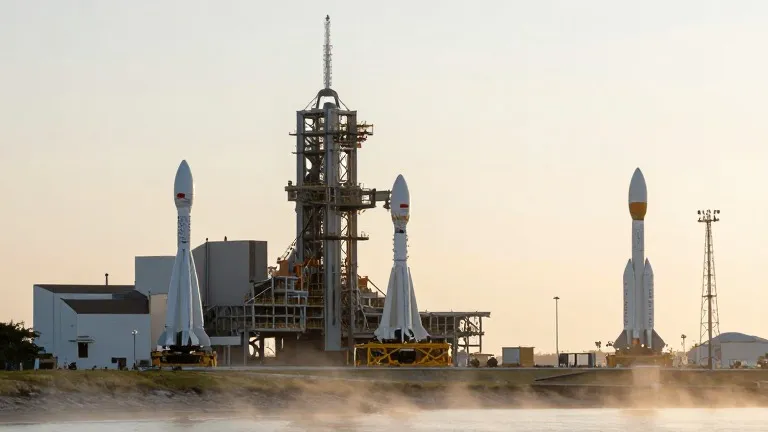
NASA detailed on Oct. 23 an Artemis III flight plan that would launch three different rockets from Florida to test two commercial moon landers before any astronaut attempts a lunar landing. Agency officials presented the concept of operations during a press conference at Kennedy Space Center that ran more than two hours.
The plan requires the Space Launch System, SpaceX's Starship and Blue Origin's New Glenn to launch from the Space Coast. Artemis program manager Jeremy Parsons called it "three of the most powerful rockets in the world" and "likely the most complicated launch campaign ever undertaken."
New Glenn would carry Blue Origin's Blue Moon lander into low Earth orbit first. The SLS would then launch the Orion capsule with four astronauts: NASA's Randy Bresnik, Andre Douglas and Frank Rubio, and the European Space Agency's Luca Parmitano. Parsons said SLS would place Orion in an elliptical orbit between 18 miles and 1,122 miles in altitude, after which the capsule would move to about 345 miles. He said the shift addresses thermal stability, since Orion was built for deep space and low Earth orbit presents a harsher thermal environment.
The crew would spend two days checking Orion systems before meeting Blue Moon on Flight Day 3 at 273 miles. Two days of docked operations would follow, with the crew entering the lander to evaluate environmental controls and life support, confirm atmospheric pressure, test emergency scenarios and dual-vehicle control, and exercise Mission Control procedures.
Around Flight Day 6, Starship is expected to launch with a custom docking adapter on its nose. The 171-foot upper stage would meet Orion on Flight Day 8 at about 237 miles for an encounter lasting roughly two hours. The crew would not enter Starship. Parsons said the meeting would still produce data on docking forces and how the two vehicles interact. After Orion undocks, the flight continues another six to nine days before a parachute-aided ocean splashdown. Nominal length is 14 days, with a possible extension to 17.
The mission would prepare Artemis IV, which NASA plans to fly in 2028 to land astronauts near the moon's south pole, the first crewed lunar touchdown since Apollo 17 in 1972. NASA Administrator Jared Isaacman said the agency is keeping both lander options open. "We have no intention of surrendering a viable path to the surface before the data and schedule compels us to do so," Isaacman said. Parsons said both providers are planning 2028 lunar landing missions: with Blue Origin, Orion meets the lander in lunar orbit; with SpaceX, Starship would likely dock with the capsule in Earth orbit and propel it toward the moon.
NASA is targeting summer 2027 for Artemis III, though Isaacman told employees in an internal memo last month that the mission was about 90 days behind schedule. Parsons cited the lunar lander supply chain as among the largest challenges. "We're moving with real speed and purpose right now," Isaacman said.
Source: Space.com