Seventh-Largest Fossil Repository Reveals Its Darkest Specimens
Researchers at the University of Texas describe the preparation challenges and eerie anatomy of prehistoric predators stored in the campus basement.
By Noah Rao ·
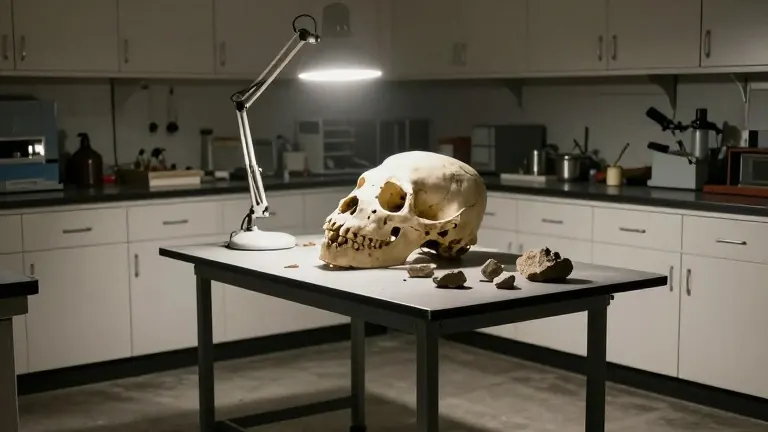
The University of Texas Dell Campus for Advanced Research houses the seventh-largest fossil repository in the United States, a status defined by its thousands of specimens spanning the Ordovician, Permian, and Triassic periods.
Ben Kligman, the Curator-in-Charge of the Texas Vertebrate Paleontology Collections, notes that many of these fossils were discovered in Texas. He imagines a scenario where the entire collection comes alive at once, stating that the building would explode and Austin would be swamped by a stampede of mammoths and mastodons.
In the dim basement, the collection includes chicken and monkey skeletons on high shelves alongside spiny fish and lizard displays. The team of paleontologists and enthusiasts cleans, prepares, and researches specimens received from across the state and country.
One of the most common finds is the metoposaurus, a Triassic species dating back 210 to 220 million years. Kligman describes the animal's head as resembling a toilet seat, a comparison echoed by researcher Erika Tandy. She notes that someone auctioned a reprinted skull a couple of years ago.
Tandy explains that she selected the metoposaurus for a photo gallery because of its teeth. The Permian and Triassic animals were often predators that fed on each other, and the metoposaurus possessed two rows of teeth along with large, tusk-like structures. She viewed these features as particularly spooky.
Kligman highlights another creature, Uatchitodon, from the Triassic period approximately 225 million years ago. The animal was the size of a small dog and had thin, curved, serrated teeth. It also had tubes running from the base to the tip of the teeth, which researchers believe were used to inject venom into prey.
The mystery of Uatchitodon is that only its teeth have been found. Fossils have been recovered from Virginia and Arizona, but the rest of the skeleton remains undiscovered.
Chris Sagebiel points to a giant sloth specimen where the back of the skull was crushed by a Homotherium, a saber-toothed cat. The puncture wounds fit the predator's teeth, but the sloth healed and continued living. John Moretti prefers to show visitors the saber-toothed cats from Friesenhahn Cave near San Antonio.
Moretti explains that the cave served as a den for generations of these cats. The accumulation of bones includes adult individuals and cubs as young as two to three months. Adjacent cabinets contain the teeth and bones of baby mammoths, which were the prey of these cats.
Tandy notes that recent fossils from the Pleistocene era, spanning 2 million to 11,700 years ago, are extremely fragile. She describes them as similar to a stale biscuit, hard outside but crumbly inside. The team uses large amounts of adhesive consolidant to stabilize this porous bone.
Kligman states that fossil preparators are the unsung heroes of the field. While collecting dinosaurs in the field is relatively easy, the laboratory work of removing rock from bone under a microscope takes the most time. He estimates that the work represents hundreds of thousands of hours from hundreds of people.
Tandy describes the experience of being the first human to see a specimen as a moment of compressed time. She finds it profound to hold a tiny tooth with tweezers and a microscope, connecting to an animal that existed millions of years before her own life.
Source: UT Austin News