68 killed in Spain's second fatal rail crash this year
A state-owned train struck a stationary private carrier in Toledo province four weeks before national elections, prompting the government to declare a three-day national mourning period.
By Karim Ramirez ·
Spain's high-speed rail network, the second largest in the world by track mileage, suffered its second fatal disaster this year when a train rear-ended a stationary vehicle on Wednesday.
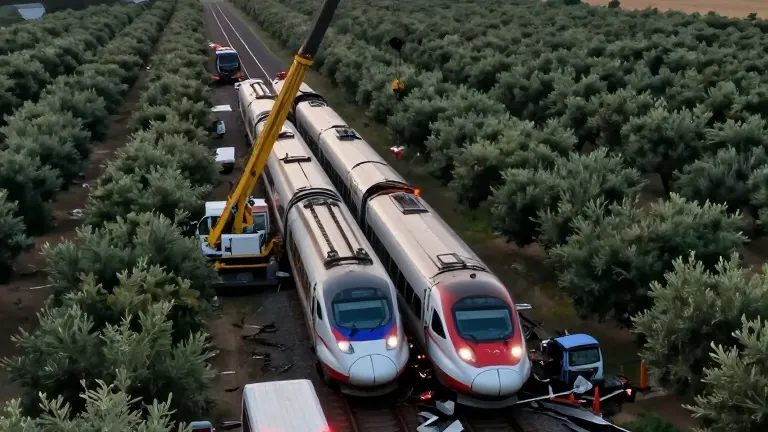
The collision occurred in the central province of Toledo, near the town of Urda, killing 68 people. The crash transformed a quiet stretch of track lined with olive groves into a scene of intense emergency activity.
Prime Minister Pedro Sánchez arrived at the site after regional authorities confirmed the death toll had surpassed 60. Dozens of injured passengers were transported to nearby hospitals for treatment.
The incident marks the second major tragedy for the system since January, when 46 people died in southern Spain after one train derailed and struck another traveling in the opposite direction.
Sánchez declared three days of national mourning beginning Thursday. He pledged a full investigation and said the government would implement improvements to prevent future accidents.
"It is clear that we need to reinforce the safety of our train service to rebuild the trust in our high-speed rail," Sánchez said. "It is not acceptable for a country like Spain to endure two high-speed train accidents in the same year."
The collision happened just four weeks before Spanish voters head to the polls in the country's first national election since 2023. Polls indicate Sánchez's Socialist party faces a difficult path to reelection.
The Prime Minister had called for early elections earlier this month, hoping to capitalize on public dissatisfaction with housing costs and high rents. On Wednesday, roughly an hour before the crash news broke, he posted on X that there were "lots of reasons to be optimistic about this country."
Transport Minister Óscar Puente stated that human error from a central command center caused the crash. He said a security system covering a 63-kilometer stretch failed due to a computer malfunction at 8:30 a.m., stopping all trains on that line.
The IRYO train was halted near Urda, while a RENFE train stopped 25 kilometers behind it. Minutes later, central command ordered the RENFE train to resume travel without speed restrictions, despite an active stop signal. The two trains collided at 8:53 a.m.
Puente noted that the engineers were not at fault and that the moving train should have been ordered to travel at a reduced speed. Both fatalities this year involved one state-owned RENFE train and one privately owned IRYO train.
Political rivals reacted sharply to the news. Alberto Núñez Feijóo, leader of the conservative Popular Party, demanded a full investigation and canceled his party's campaign events for the day to honor the victims. Santiago Abascal of the far-right Vox party described the government as a criminal organization and vowed to keep it in a courtroom until it answers for its actions.
Source: KGOU