Nine Die As Learjet Plunges To Earth In Florida
The private jet fell about 26,500 feet in one minute before exploding near a busy road in Palm Beach County, killing all aboard.
By Karim Ramirez ·
All nine individuals aboard a Learjet 60 business jet died Sunday, November 1, 2026, when the aircraft crashed into a residential area in Palm Beach County, Florida. U.S. Transportation Secretary Sean Duffy confirmed the fatalities, describing the event as a horrific tragedy in a social media post. The Federal Aviation Administration stated the impact occurred at approximately 12:50 p.m. Eastern time. The jet had departed from Austin-Bergstrom International Airport in Texas and was en route to North Eleuthera Airport in the Bahamas.
The National Transportation Safety Board is leading the investigation and said Sunday it was launching a go-team. Investigators were expected to arrive Sunday and Monday morning. The agency plans to hold a media briefing in West Palm Beach on Monday. No official cause for the crash has been determined at this time. Officials have not released the names of the victims or clarified the split between passengers and crew.
Jim Reynolds, a spokesperson for Austin-Bergstrom International Airport, identified the aircraft as a private plane. He said he could not say who was on the flight, adding, "This is definitely a tragedy." The crash site is located in Greenacres, a city of roughly 45,000 residents situated about seven miles southwest of West Palm Beach. The specific location is near Military Trail, between Cresthaven Boulevard and 10th Avenue North. This site lies approximately four miles south of the local airport, which was renamed President Donald J. Trump International Airport earlier this year.
Florida Governor Ron DeSantis visited the scene and described the event to reporters as a cataclysmic plane crash. He noted that the aircraft appeared to descend like a missile, leaving a large crater on the roadside. DeSantis stated there were no reports of ground fatalities or injuries at the time of his press conference. He praised the rapid response of Palm Beach County first responders and noted that the debris field stretched a considerable distance.
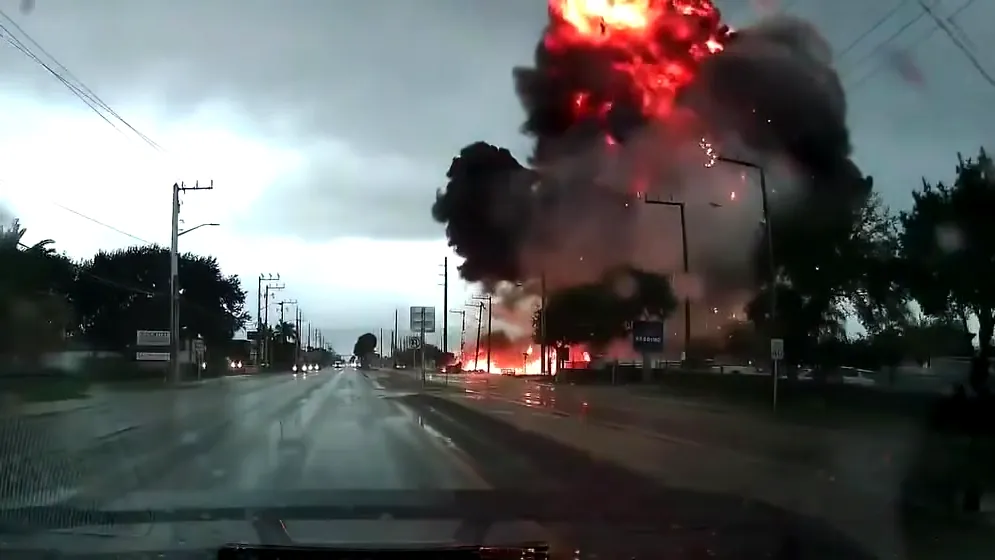
Witnesses in nearby vehicles captured video of the jet plunging from the sky. The footage shows the aircraft striking near the roadway and exploding. Flames surrounded chunks of pavement lining the crater, which was located feet from homes and inches from passing vehicles. Thick black smoke obscured the site, and video from WPBF showed the road surface buckled where the jet made impact.
Anthony Blackmon, a resident about 500 feet from the crash, reported that debris hit his house and that the road caught fire. He said he had never imagined the event would happen so close to his home. Roger Forcelle stated that he felt the aircraft pass over his house, causing it to shake. He estimated the crash occurred less than half a mile from his residence. Andrew Mannino told CNN that he heard and felt the boom and that power immediately went out. He smelled smoke and saw a large black cloud rise into the air. One observer described the aftermath as looking like a meteor had struck the ground. A nearby worker reported that electricity had been out for about two hours.
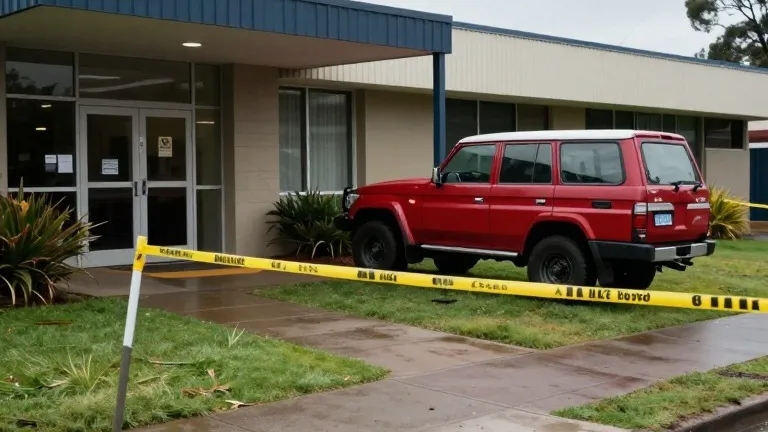
Approximately 600 residents in a mobile home community were required to leave their homes Sunday night. The crash scene blocks the entrance to the park and is being treated as a crime scene while federal investigators work. No official has alleged that a crime took place. Palm Beach County Commissioner Joel Flores, who was the first county official at the scene, said residents were being sent to two county shelters. He noted that the Red Cross was standing by and that Palm Tran buses were ready to transport residents once law enforcement authorized the evacuation.
The county closed Military Trail between 10th Avenue North and Purdy Lane/Alameda Drive until further notice. The road remains open only to emergency vehicles. Drivers were instructed to use 10th Avenue North and Purdy Lane/Alameda Drive for east-west travel. Haverhill Road and Kirk Road were designated for north-south travel. A county commissioner warned that the road could remain closed for an extended period due to the crater. The timeline for reopening also depends on the federal investigation.
Air traffic control recordings indicate the jet was flying east at about 35,000 feet when pilots reported turbulence, icing, and precipitation. The crew requested to climb 2,000 feet. Minutes before the crash, the pilot told the Miami Air Route Traffic Control Center that the ice was light, clear, and manageable, with moderate turbulence. The pilot reported an outside air temperature of minus 47 degrees Celsius and turbulence that was bouncing the jet by as much as 700 feet.
After the precipitation report, the situation deteriorated rapidly. The pilot radioed that the jet was descending 8,000 feet, then declared a mayday and reported a descent of 10,000 feet per minute. The pilot then stated the aircraft was in an overspeed condition descending 20,000 feet per minute. The pilot then said, "We're going to crash into the ground." CBS News reported the pilot also said, "We're out of time." The descent rate increased to as high as 30,000 feet per minute, pushing the jet beyond its design limits. The plane banked sharply to the right before hitting the ground at a steep angle.
The FAA reported the jet fell from 35,250 feet to 8,750 feet in one minute before the crash. Flight tracking site ADS-B Exchange showed a drop of 27,000 feet in about a minute before the data cut off. Scattered storms were in the area, and the jet passed through a stronger storm cell shortly before the descent. The flight was in an area where the FAA had issued a convective SIGMET warning of thunderstorms. Heavy rain fell across the region Sunday, and the National Weather Service had a flood watch in effect through Monday afternoon.
In January 2024, the NTSB issued a safety alert on in-flight icing. The alert warned that ice can make managing the airplane's flightpath and airspeed more difficult and can prevent the airplane from maintaining level flight. Mary Schiavo, a CNN aviation analyst and former inspector general of the U.S. Transportation Department, said dashcam video will be important to investigators. She stated that the steep dive was not a controlled descent and that the crew had lost control of the plane. The steep dive could have torn parts off the plane, and a flight recorder could have been destroyed in the explosion. It is not known whether the jet carried a cockpit voice recorder. FAA rules require multi-engine jets to carry one only when flown for hire, and records show the jet was offered for charter flights.
Flight tracking and FAA registry data identify the jet by its registration, N722BD. The FAA registry lists it as a Learjet 60 owned by LR60271 LLC of Wilmington, Delaware. CNN reported the jet is listed online as available for charter. Officials have not said who operated the flight. The crash is the deadliest ever involving a Learjet 60, according to Flight Safety Foundation data. In 2008, four people were killed when a Learjet 60 bound for Los Angeles crashed on takeoff in Columbia, South Carolina. NTSB records show it is the second deadliest crash in the United States this year, after a skydiving plane crash in Butler, Missouri, in June that killed 12. Learjet, the brand that Bill Lear's Lear 23 made famous with wealthy travelers in the 1960s, was most recently built by Canadian manufacturer Bombardier, which stopped making new Learjets in 2021 but still supports the planes in service.
Source: Associated Press