Moon Water Reserves May Cap Settlement Size
A new study suggests lunar water levels support small towns for centuries, but mega-cities could exhaust supply within a century.
By Karim Ramirez ·
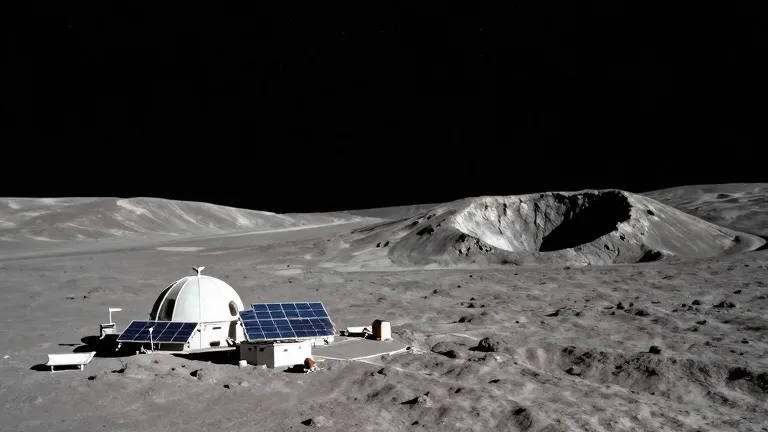
Ambitious plans for large-scale human habitation on the moon face a physical constraint that power sources do not. While solar and nuclear energy can theoretically sustain a population of one million, the available water supply may be far too limited to support such a demographic for more than a short period.
The timeline of lunar colonization ambitions has accelerated recently. In February, Elon Musk, chief executive of SpaceX, stated that the company shifted its primary focus from Mars to building a self-growing city on the moon. He predicted this could happen in under ten years. Jeff Bezos, head of Blue Origin, has separately claimed that millions of people will live in space by 2045. These public statements prompted a closer scientific examination of the resources required to make such claims viable.
Martin Elvis, a senior astrophysicist at Harvard University's Smithsonian Astrophysical Observatory, and Jonathan McDowell, an honorary professor at the Durham University Space Research Centre, analyzed these projections. Their paper in Frontiers in Space Technologies evaluates two critical resources: power and water. The researchers determined that energy generation is manageable. Solar and nuclear systems would provide sufficient power for one million lunar residents. Water, however, presents a different challenge. Current estimates place the total water inventory at roughly one billion tonnes, primarily located in permanently shadowed polar regions.
The math reveals a tight margin. Under the assumption that a lunar settlement recycles 98 percent of its water, a population of one million would consume the estimated supply in approximately 100 years. A smaller community of 10,000 people would remain sustainable for centuries. Elvis compared the total water reserve to an aquarium the size of Central Park filled until the Statue of Liberty was just underwater, describing it as a small lake that could not supply a big city for long.
The researchers suggest the current one billion tonne estimate may be optimistic. Elvis believes the actual amount could be 20 to 30 times smaller. He estimates that only one percent of the water is reliably accessible, which would reduce the lifespan of a million-person city to about one year. Gordon Osinski, a planetary geology professor at Western University in London, Ontario, noted that satellite measurements contain uncertainties. He suggested the water might resemble Arctic permafrost, consisting of sub-millimetre ice crystals mixed into soil, making extraction difficult.
The findings imply that future lunar architecture must prioritize efficiency or alternative water sourcing. McDowell stated that if the goal is to cover the moon with cities, engineers must find a way to transport water to the sites, as it is not currently available in sufficient quantities. He added that the goal is to understand the constraints rather than discourage exploration, noting that trying to build without understanding the limits is the negative approach.
Source: CBC News